

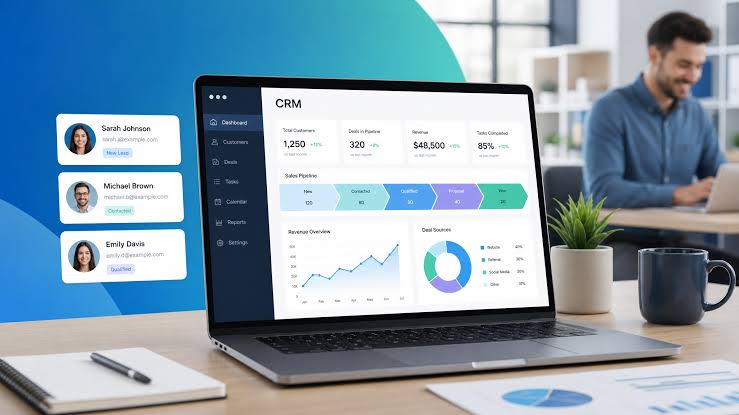
The best crm software for small business in 2026 is the one that matches a company’s actual sales process, not necessarily the platform with the most features, since small teams get more value from a simple system everyone uses correctly than a powerful one that sits half-configured. Choosing CRM software has become more confusing rather than less over the past few years, with dozens of platforms all claiming to be the right fit for a growing business.
Small businesses often make the mistake of choosing a CRM based on brand recognition rather than actual workflow fit. A platform built for enterprise sales teams with complex approval chains can overwhelm a five-person team that just needs to track leads, log calls, and remember to follow up. A better approach starts with mapping out the sales process the team already follows, then finding software that supports that process without adding unnecessary complexity.
- Sales Pipeline Tracking Should Match How the Team Actually Sells
- Contact Database Management Needs to Scale With Growth
- Customer Relationship Management Software Pricing Models Vary Widely
- Sales Automation Workflow Features Save Real Time
- Ease of Setup Matters More for Small Teams Than Feature Count
- Questions to Ask Before Committing to a Platform
- FAQs
Sales Pipeline Tracking Should Match How the Team Actually Sells
Sales pipeline tracking is the core function of nearly every CRM, but the way pipelines get structured varies a lot between platforms. A crm software comparison should look closely at whether a platform allows custom pipeline stages that match the business’s actual sales cycle, rather than forcing a rigid, generic set of stages that do not reflect how deals really move from lead to close.
Contact Database Management Needs to Scale With Growth
Contact database management becomes a real problem once a business grows past a few hundred contacts tracked in spreadsheets or scattered across individual employees’ phones and email accounts. Small business CRM tools worth considering should make it easy to import existing contacts, avoid duplicate entries automatically, and let the whole team see the same up-to-date contact information rather than siloed personal lists.
For businesses comparing platforms side by side before committing, you can compare CRM tools in this directory to see feature and pricing differences across the most commonly used options.
Customer Relationship Management Software Pricing Models Vary Widely
Customer relationship management software pricing ranges from free plans with limited contacts and features to enterprise tiers costing well over a hundred dollars per user each month. Small businesses should pay close attention to per-user pricing structures, since a platform that looks affordable at five users can become expensive quickly once a sales team doubles in size. Annual contracts sometimes offer a discount but can lock a growing business into a plan that no longer fits a year later.
Sales Automation Workflow Features Save Real Time
Sales automation workflow features, such as automatic follow-up reminders, email sequences, and lead scoring, separate a basic contact list from a genuine sales tool. Top crm 2026 comparisons consistently show that small businesses get the most value from automation features that reduce manual admin work, like automatically logging a call or sending a follow-up email, rather than complex automation built for large sales organizations with dedicated operations teams.
Ease of Setup Matters More for Small Teams Than Feature Count
A small business rarely has a dedicated IT person to configure a complex CRM, which makes ease of setup one of the most practical factors in choosing software. A platform that takes a single afternoon to set up and gets the team using it immediately delivers more real value than a feature-rich system that takes weeks to configure and never gets fully adopted by the team.
Questions to Ask Before Committing to a Platform
Before signing up for any CRM, a small business should confirm how easily data can be exported if the company later switches platforms, whether the pricing scales predictably as the team grows, and whether the vendor offers real customer support rather than just a help center of articles. These questions matter more in year two and three of using a CRM than they do during the initial free trial.
FAQs
Is a free CRM plan enough for a small business just starting out? Often yes, for a team under five users with a simple sales process, though most free plans cap the number of contacts or automation features available as the business grows.
How long does it typically take a small team to fully adopt a new CRM? Most small teams see full adoption within two to four weeks, assuming the platform is set up with a pipeline structure that actually matches how the team already sells.
Should a small business choose a CRM based on integrations with other tools? Yes, integrations matter significantly, especially with email, calendar, and any digital business card or lead capture tools the team already uses to bring new contacts into the pipeline.
Finding the best crm software for small business ultimately comes down to matching the platform to the team’s real sales process and growth stage, rather than choosing based on which tool has the longest feature list.

